> ## Documentation Index
> Fetch the complete documentation index at: https://docs.customei.com/llms.txt
> Use this file to discover all available pages before exploring further.
# Assets
> One place for the pictures, product photos, colours and fonts your designs draw from.
**Assets** is your storeroom. Everything a design template can pull in lives here: the pictures a layer can swap between, the product photos your previews sit on, your brand colours, your fonts.
You group them into **libraries**. A library is just a named box of one kind of thing, for example *Dog breeds* holding 24 dog pictures. A design template layer points at a library, and from then on every one of those pictures is a choice your customer can pick.
Open it from **Assets** in the left menu.
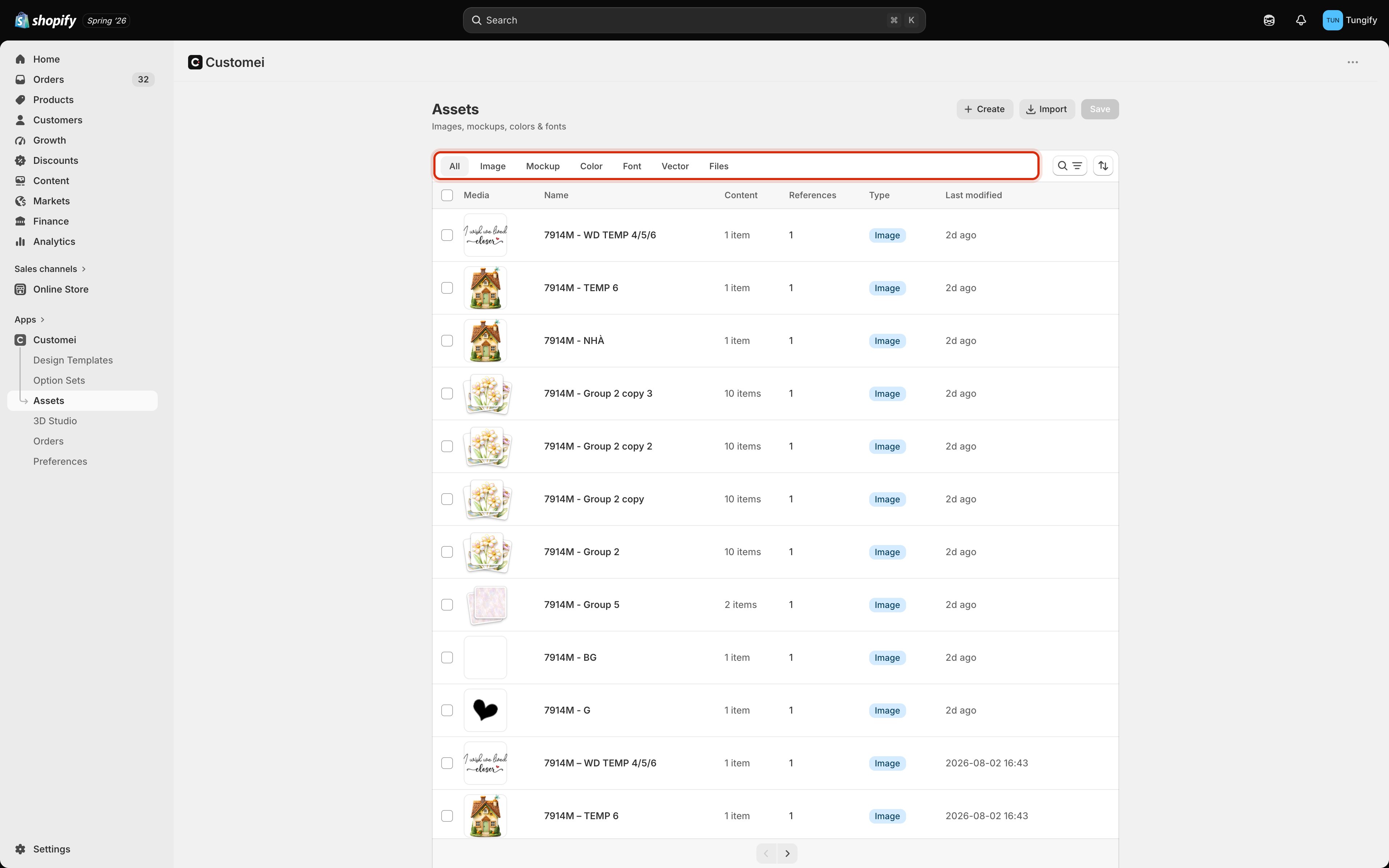 ## The tabs
| Tab | What it lists |
| ---------- | ------------------------------------------------------- |
| **All** | Every library you have |
| **Image** | Libraries of pictures and graphics |
| **Mockup** | Libraries of product photos used for previews |
| **Color** | Sets of colour swatches |
| **Font** | Sets of font files |
| **Vector** | Libraries of vector artwork |
| **Files** | Not libraries. Every single file you have ever uploaded |
Customei remembers which tab you were last on, so Assets may not open on **All**.
## The five kinds of library
Pick the kind when you create a library. It decides what you can put in and where it can be used.
| Kind | Holds | Used for |
| ---------- | --------------------------------------- | ---------------------------------------------------------------------- |
| **Image** | .gif, .jpg, .png pictures | The choices behind a picture layer, so a customer can swap the artwork |
| **Mockup** | Product photos, and 3D models | Showing a design on a real product in the preview |
| **Color** | Colour swatches, in **RGB** or **CMYK** | The colour choices behind a text or image colour option |
| **Font** | .woff, .woff2, .ttf, .otf files | The font choices behind a text layer |
| **Vector** | .svg, .pdf, .eps, .ai artwork | Vector artwork you keep for print work |
Colour mode is part of the kind: an **RGB** library suits anything shown on screen, a **CMYK** library matches what your printer expects. Choose it when you create the library.
## Reading a row
| Column | What it tells you |
| ----------------- | ------------------------------------------------------------------------------- |
| **Media** | A stacked thumbnail of what's inside |
| **Name** | Click it to open the library |
| **Content** | How many items, or how many categories, are in there |
| **References** | How many design templates use this library. Click the number to see which ones |
| **Type** | Which kind of library it is. Only on the **All** tab, where the kinds are mixed |
| **Last modified** | When anything in it last changed |
A dash in **References** means either nothing uses this library or Customei hasn't finished counting. It never shows a bare `0`, because "nothing uses this" is a dangerous thing to guess at just before you delete something.
Click the number and you get the list.
## The tabs
| Tab | What it lists |
| ---------- | ------------------------------------------------------- |
| **All** | Every library you have |
| **Image** | Libraries of pictures and graphics |
| **Mockup** | Libraries of product photos used for previews |
| **Color** | Sets of colour swatches |
| **Font** | Sets of font files |
| **Vector** | Libraries of vector artwork |
| **Files** | Not libraries. Every single file you have ever uploaded |
Customei remembers which tab you were last on, so Assets may not open on **All**.
## The five kinds of library
Pick the kind when you create a library. It decides what you can put in and where it can be used.
| Kind | Holds | Used for |
| ---------- | --------------------------------------- | ---------------------------------------------------------------------- |
| **Image** | .gif, .jpg, .png pictures | The choices behind a picture layer, so a customer can swap the artwork |
| **Mockup** | Product photos, and 3D models | Showing a design on a real product in the preview |
| **Color** | Colour swatches, in **RGB** or **CMYK** | The colour choices behind a text or image colour option |
| **Font** | .woff, .woff2, .ttf, .otf files | The font choices behind a text layer |
| **Vector** | .svg, .pdf, .eps, .ai artwork | Vector artwork you keep for print work |
Colour mode is part of the kind: an **RGB** library suits anything shown on screen, a **CMYK** library matches what your printer expects. Choose it when you create the library.
## Reading a row
| Column | What it tells you |
| ----------------- | ------------------------------------------------------------------------------- |
| **Media** | A stacked thumbnail of what's inside |
| **Name** | Click it to open the library |
| **Content** | How many items, or how many categories, are in there |
| **References** | How many design templates use this library. Click the number to see which ones |
| **Type** | Which kind of library it is. Only on the **All** tab, where the kinds are mixed |
| **Last modified** | When anything in it last changed |
A dash in **References** means either nothing uses this library or Customei hasn't finished counting. It never shows a bare `0`, because "nothing uses this" is a dangerous thing to guess at just before you delete something.
Click the number and you get the list.
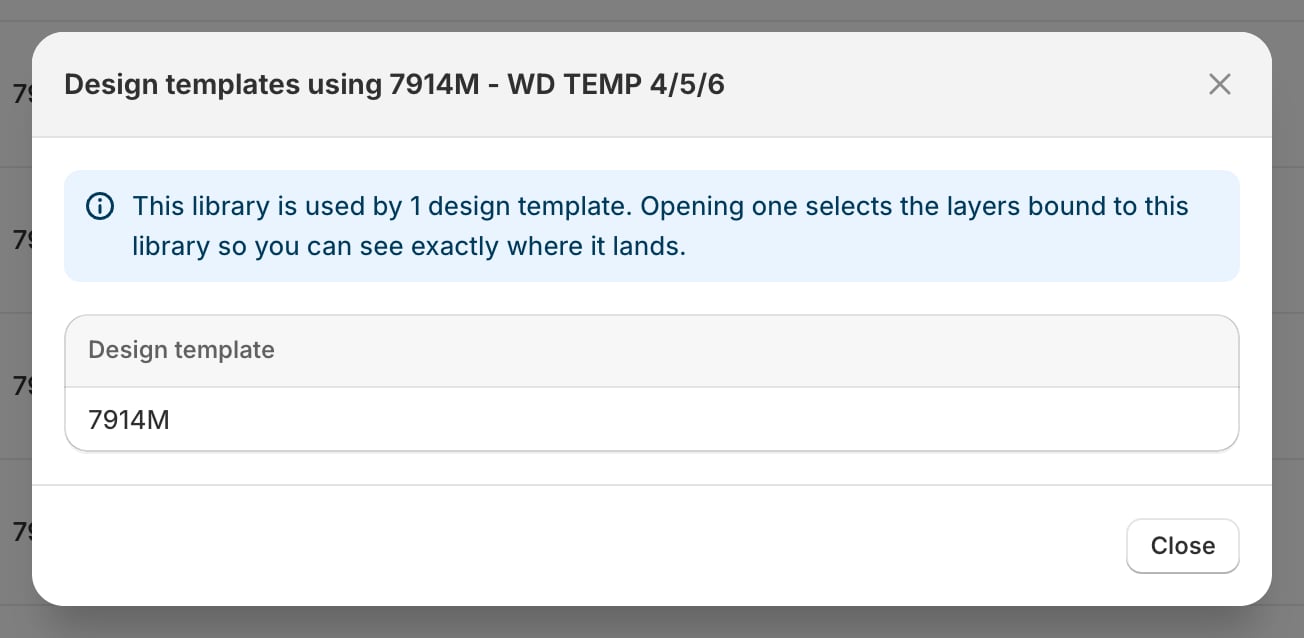 Do that before you rename, empty or delete anything. Opening a template from this list lands you on the exact layers that draw from the library, which is much faster than hunting through the Layers panel.
The **...** menu at the end of a row has **Edit**, **Settings**, **Duplicate** and **Move to trash**.
Use the search icon above the table to find a library by name. With dozens of libraries that beats scrolling.
## Who is using this library
Open a library and a blue banner at the top tells you what depends on it: **Used in N design templates**, with a **View** button. Opening a template from there selects the layers bound to this library, so you can see exactly where these pictures land.
Do that before you rename, empty or delete anything. Opening a template from this list lands you on the exact layers that draw from the library, which is much faster than hunting through the Layers panel.
The **...** menu at the end of a row has **Edit**, **Settings**, **Duplicate** and **Move to trash**.
Use the search icon above the table to find a library by name. With dozens of libraries that beats scrolling.
## Who is using this library
Open a library and a blue banner at the top tells you what depends on it: **Used in N design templates**, with a **View** button. Opening a template from there selects the layers bound to this library, so you can see exactly where these pictures land.
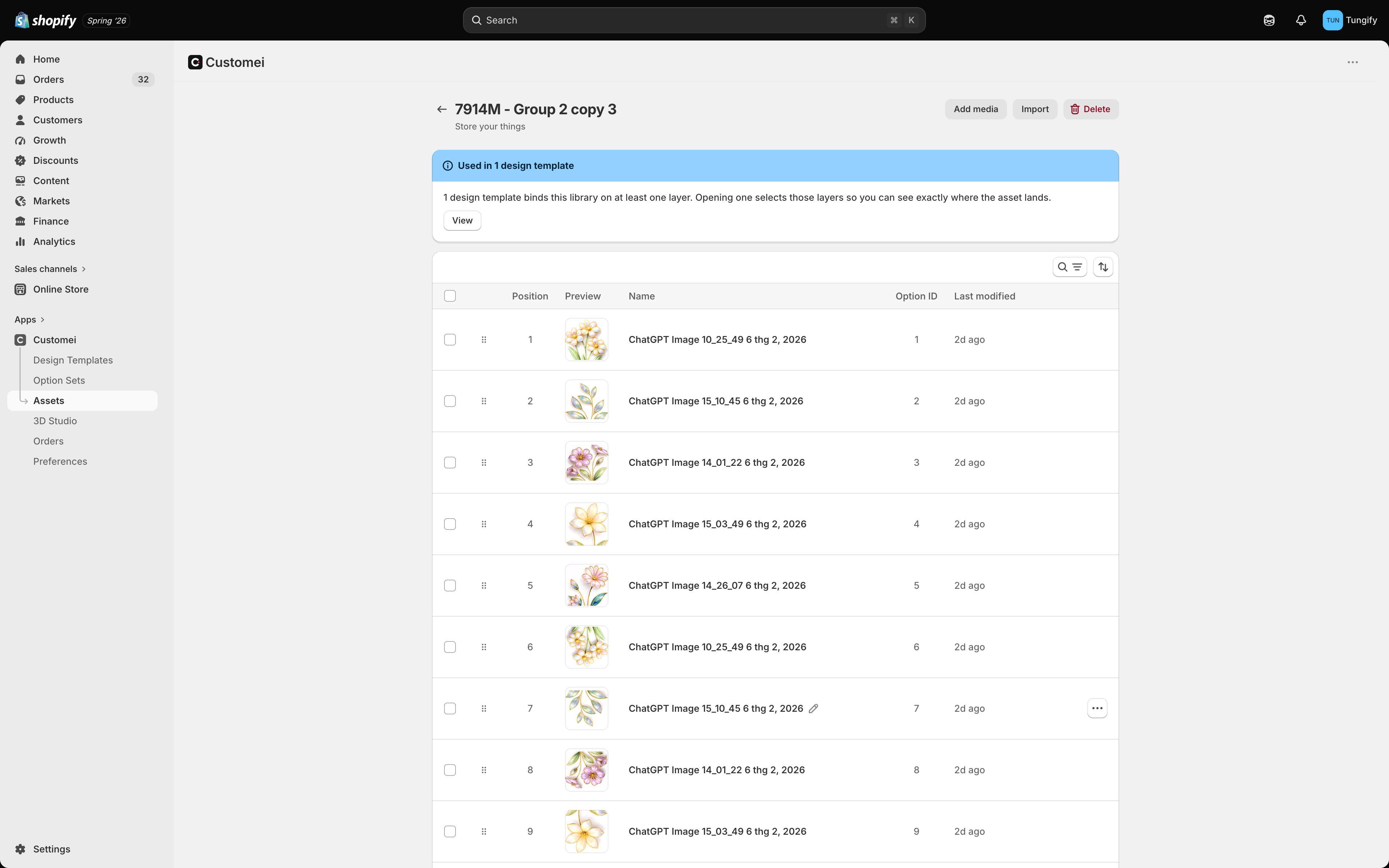 If a library also feeds option sets through a design template, a second banner says **Auto-syncs to N option sets** and lists them, with how many of their questions come from this library and how many products they're on. That's the useful bit: add a picture here and every one of those option sets can offer it, without you editing each one by hand.
[Options that keep themselves up to date](/optionsets/keep-options-up-to-date) covers the other end of that link.
## Trash and restore
**Move to trash** takes a library out of your way without destroying it. Trash keeps it for **30 days**, then it goes for good.
If a library also feeds option sets through a design template, a second banner says **Auto-syncs to N option sets** and lists them, with how many of their questions come from this library and how many products they're on. That's the useful bit: add a picture here and every one of those option sets can offer it, without you editing each one by hand.
[Options that keep themselves up to date](/optionsets/keep-options-up-to-date) covers the other end of that link.
## Trash and restore
**Move to trash** takes a library out of your way without destroying it. Trash keeps it for **30 days**, then it goes for good.
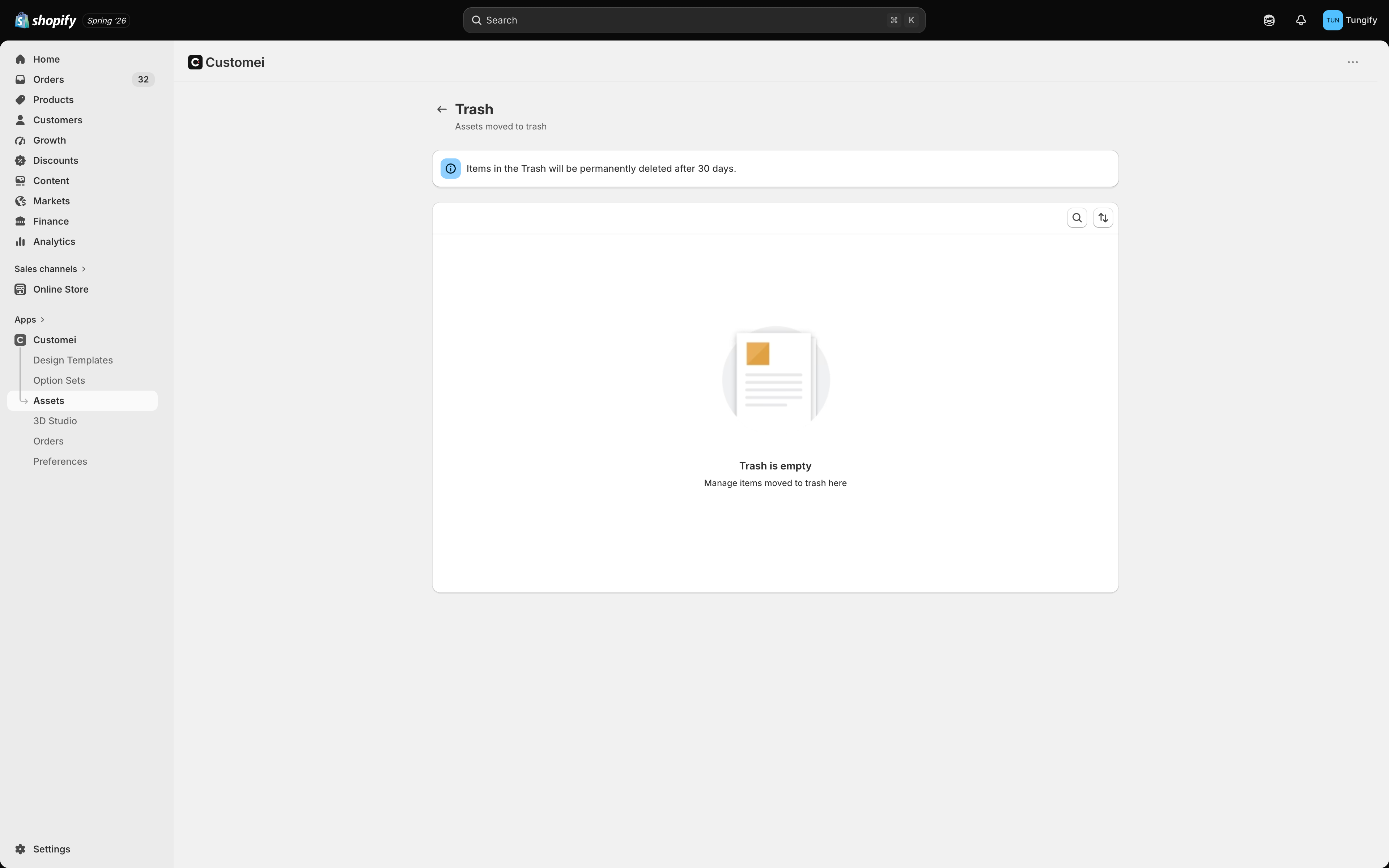 A library still in use by a design template is not protected. Move it to trash and the layers pointing at it lose their choices, so check the **References** count first.
## Where to next
Make a box, choose its kind, and organise it with categories.
Add pictures, fonts and colours, or bring in a whole ZIP.
The Files tab: what uses a file, and deleting safely.
How a library becomes a set of choices for your customer.
A library still in use by a design template is not protected. Move it to trash and the layers pointing at it lose their choices, so check the **References** count first.
## Where to next
Make a box, choose its kind, and organise it with categories.
Add pictures, fonts and colours, or bring in a whole ZIP.
The Files tab: what uses a file, and deleting safely.
How a library becomes a set of choices for your customer.